Geography
How are landscapes formed? How do we deal with natural hazards? And how is the soil affected by climate change? If you are interested in these questions, this is the programme for you!
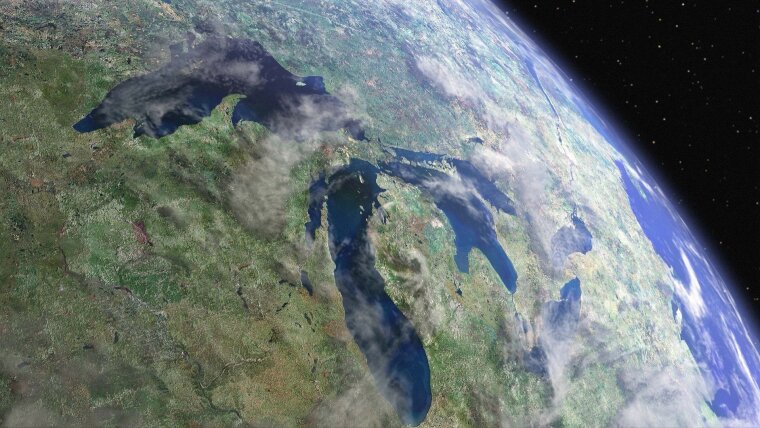
Have you always had an interest in towns, cities, countries and landscapes? Great! You’ve got a solid foundation. But there is more to the subject of ‘Geography’ than topographical knowledge. You need a flair for research! During your studies, you will focus on the surface of the earth, societies, spatial structures and their material and intellectual environments—in other words, you will examine both the physical and social world.
And what do you need? Various tools, of course! Geographers gain their knowledge mainly through maps, fieldwork and laboratory studies, as well as through social scientific methods. And they also use aerial and satellite images and geographic information systems, which enable the analysis and visualization of spatial data. These tools will allow you to examine current geographical issues, such as sustainability, resource management, globalization, and social and spatial change.
Your studies will introduce you to various branches of geography, such as natural sciences (Physical Geography and Soil Science), social sciences, economics and humanities (Human Geography), and technical and practical areas (Geoinformatics and Earth Observation).
A student, Max, talks about his Geography degree at the University of Jena [in German].
Image: FSUDigital discovery tour with free app: Would you like to find out more about our degree in Geography with fun quiz questions and puzzles? Click here for our interactive discovery tour app [in German].
The bachelor's degree is the first professional qualification. The standard period of study is a total of six semesters, during which various forms of courses (e.g. seminars, lectures or practical courses) are offered for the individual modules.
If you take a single-subject bachelor’s programme in ‘Geography’, your field of study will comprise 180 credits (ECTS for short; 1 ECTS = 30 hours for attendance, preparation and follow-up work, private study, assessed coursework and examinations).
Your study programme will teach you all the basics and give you the opportunity to specialize in a specific branch of geography. You can choose from the following areas of specialization:
In the first two semesters, the foundations are laid for all three areas of specialization. You will then be able to focus on a specific field from the third semester onwards. The sixth semester is dedicated to practical training and research.
You can also supplement your studies with interdisciplinary modules, including foreign languages and courses offered for related study programmes, such as Geology, Ecology, Computer Science and Business Administration.
| 1st semester |
2nd semester |
3rd semester |
4th semester |
5th semester |
6th semester |
| Technical Foundations (30 ECTS): | Required elective modules (3 x 5 ECTS): |
Required elective modules (40 ECTS each): specialization opportunities in one of the geographic fields |
Vocational internship for 9 weeks (13 ECTS) |
||
|
|
|
Bachelor’s Thesis (12 ECTS) |
||
| Basic Methods (30 ECTS): | Compulsory modules (5 ECTS): |
Compulsory modules (at least 5 ECTS): | |||
| Scientific Work | Earth History | Applied Image Processing | Module(s) in a geographical field other than the chosen area of specialization | ||
| Statistics | Context area (max. 30 ECTS): | ||||
| Cartography | Geoinformation Systems | Selection of interdisciplinary modules or other modules from the geographic department | |||
Short form: ECTS = credit points (European Credit Transfer System)
More detailed information can be found in the module catalogue for the study programme [in German].External link

Prof. Dr. Alexander Brenning
Image: Anne Günther (University of Jena)
As geographers, we are interested in the relationship between people and the environment. As a geoinformatics specialist, I give students the methods and tools they often need to kick-start their careers, and I find practical exercises really important.
Prof. Dr Alexander Brenning, Professor of Geoinformatics
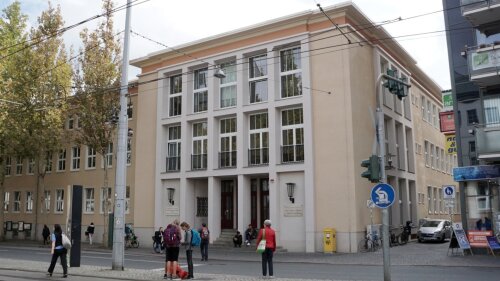
Since 1992, our Institute of Geography has developed into one of the most important in the German-speaking world, representing the entire range of geographic disciplines with seven professorships. The institute is located at Löbdergraben 32 in Jena—right in the city centre.
Areas of employment for graduates
A university entrance qualification, such as a general secondary school leaving certificate, is required for admission onto the study programme.
More information on university entrance qualifications can be found here.
The study programme is taught in German. You must therefore have a very good command of German at the start of the study programme.
Room 309.1
Löbdergraben 32
07743 Jena
Google Maps site planExternal link
Humboldtstraße 11
07743 Jena
Google Maps site planExternal link
Room 204
Löbdergraben 32
07743 Jena
Google Maps site planExternal link
University Main Building / SSZ
Fürstengraben 1
07743 Jena
Google Maps site planExternal link
Office hours:
We offer consultations in person, by telephone, and via Zoom. You can make an appointment by calling us on +49 3641 9-411111 (Mondays to Fridays from 9:00 to 11:00) or outside these office hours on +49 3641 9-411200. You can also use our remote help desk.
Consultation hours:
Mondays, Tuesdays, Thursdays and Fridays (9:00 to 12:20), Tuesdays (14:00 to 18:00), and Wednesdays and Thursdays (14:00 to 16:00).
Video chat: To the video chat – Zoom Videochat ZeitenMondays to Fridays (12:30 to 13:00) Password ZSB2020 Data protection informationpdf, 101 kb
University Main Building, Room E065
Fürstengraben 1
07743 Jena
Google Maps site planExternal link
Opening hours:
Information Desk (UHG; Room E0.65)
Mondays (10:00 – 12:00)
Tuesdays (13:00 – 15:00)
Wednesdays (10:00 – 12:00)
Thursdays (13:00 – 15:00)
Fridays (10:00 – 12:00)
You can also use our remote help desk at
www.uni-jena.de/service-ssz
or send us your enquiries by post.
Telephone hours:
Mondays to Fridays
(9:00 – 11:00)
Postal address:
Friedrich-Schiller-Universität Jena
Studierenden-Service-Zentrum
07737 Jena