Programme content
There are always athletes or teams who are ahead by a nose and win almost every game—as is the case with the rarely beaten New Zealand men's rugby union team. What is the secret behind their success that has lasted for decades? Is it based on technical superiority, tactics, or rather mental strength? Sports scientists try to investigate the scientific background of such phenomena and derive guidelines for action.
What is it that makes individual athletes and teams successful? What evidence is there for the effectiveness of different training interventions and methods? How can these findings be substantiated scientifically? Sports science finds answers to all these questions in its numerous disciplines such as sports medicine, training science or sports psychology. At the centre of these research activities are various measurement and research methods, which you will learn about in detail during the course of your studies. It is our goal to make you completely fit for the fields of ‘Performance’ and ‘Health’ in this respect. Are you wondering what it takes? That is quite simple: First, you should be interested in the unbelievably many facets of sport, and second, you should have an open mind for the close link between theory and sports practice, including your own research activities in this subject area! The latter is at the same time the special element of the study programme ‘Sports Science – Performance & Health’ at the University of Jena.
The focus of this Bachelor's programme is on the scientific perspective on a wide range of physical activities. During your studies, you also have the opportunity to set individual focuses and optimally fleshing out your qualification profile for your future career in the field of ‘Sports and Health’. If you are enthusiastic about scientific reasoning and strenuous mental work and possess a large portion of curiosity, you have the best prerequisites for this degree programme.
Are you interested? Great! Then all that is left to say is: Ready (to study), set, go!
Digital discovery tour with free app: Would you like to find out more about our degree in Geography with fun quiz questions and puzzles? Click here for our interactive discovery tour app.
Structure
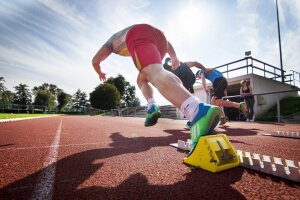
students doing sports
Image: Franz SurekThe bachelor's degree is the first professional qualification. The standard period of study is six semesters, during which various forms of courses (e.g. lectures, seminars or practical courses) are offered for the individual modules.
In the single-subject Bachelor’s programme ‘Sports Science – Performance & Health’, the focus is on one subject comprising 180 credits points (CP; 1 CP = 30 hours for attendance, preparation and follow-up work, private study, assessed coursework and examinations).
The study programme includes an internship and various modules on the basic and in-depth aspects of sports science, as well as on movement practice and research methods.
How might your degree programme shape up?
|
1st semester |
2nd semester |
3rd semester |
4th semester | 5th semester | 6th semester |
| Fundamental Scientific Skills in Sports Science (8 CP) |
Basics of Sports Pedagogy (8 CP) |
Testing in Human Movement Science and Exercise Physiology (4 CP) |
Performance & Health in Sports Pedagogy (4 CP) |
||
| Fundamentals of exercise science (8 CP) |
Natural Sciences or Social Sciences Elective module* (8 CP) |
Advanced Course in Sports Medicine and Health Promotion I (8 CP) |
Advanced Course in Sports Medicine and Health Promotion II (8 CP) |
||
| An Introduction to Human Movement Science (Part 1, 4 CP) |
An Introduction to the Psychology of Human Movement and Sport (Part 1, 4 CP) |
An Introduction to Human Movement Science (Part 2, 4 CP) |
An Introduction to the Psychology of Human Movement and Sport (Part 2, 4 CP) |
Methods and Statistics in Sports (12 CP) |
|
| An Introduction to Sports Medicine and Health Promotion (8 CP) |
Applied Methods in Sports Sciences I (12 CP) |
Advanced Course on the Psychology of Human Movement and Sport (4 CP) |
Bachelor thesis (12 CP) |
||
| Basics of Sports Economics (8 CP) |
Applied Methods in Sports Sciences II (8 CP) |
Empirical Research Training (8 CP) |
|||
| Evidence-based Interventions (6 CP) |
Statistics in Sports (8 CP) |
Internship (9 CP) |
|||
| General Key Qualification (5 CP) |
Research Methods in Sports (8 CP) |
||||
Abbreviations: CP = credit points
* In the elective area, various courses are offered: These include, for example, lectures on Sports History, Sports Philosophy or Sports Ethics in the Social Sciences elective, and on Computer Science in Sports or medical application fields in the Natural Sciences elective.
More detailed information can be found in the module catalogue for the study programme [in German].External link
Why study in Jena?
Prof. Dr. Rouwen Cañal-Bruland
Image: Anne Günther (University of Jena)Short distances, research-oriented teaching and intensive support enable students to develop competencies that prepare them for the diverse and constantly changing demands of future careers in the field of sport, exercise and health.
Prof. Dr Rouwen Cañal-Bruland
Professor of Psychology of Human Movement and Sport
- Excellent teaching: Experienced teaching staff and modern training concepts ensure that graduates earn a top quality and internationally recognized degree and thus the best possible qualifications for the demands of the labour market.
- Good ratings: In teaching evaluations, the University's sports science programmes always achieve above-average positions. The reason is simple: It is mainly due to the good supervision ratio and the qualified specialists in teaching and research.
- Innovative research: The Institute covers the core areas of sports science. The research profile is characterized by a clear orientation towards the topic of ‘Health’.
- Top facilities: Modern sports facilities, lecture theatres and seminar rooms await you at the Institute of Sports Science in Jena.
- Adventure abroad: If you dream of spending a semester abroad, you can easily make it come true. Our University has a worldwide network of partner universitiesExternal link.
What can you do after your studies?
Areas of employment for graduates
Sportutensilien
Image: Christoph Worsch (University of Jena)- fitness management / gyms
- working for clubs / coaching / sports associations
- public health and mass sports
- hospitals and rehabilitation centres
- sporting goods manufacturers
- workplace health promotion
- public health education / health insurance providers
- employer’s liability insurance associations
- scientific career
- product development
- sports journalism
Downloads and links for the degree programme
What are we looking for in prospective students?
- interest in research questions and scientific methods
- a broad general education
- love of sports and exercise
- creativity and ability to improvise
Admission requirements
-
University entrance qualification
A university entrance qualification, such as a general secondary school leaving certificate, is required for admission onto the study programme.
More information on university entrance qualifications can be found here.
-
Medical certificate
In order to be admitted to a sports science programme at Friedrich Schiller University Jena, you must provide doctor’s certificate confirming your medical eligibility.
-
Language requirements
Admission and language requirements for applicants of foreign nationality and without German Abitur: www.uni-jena.de/en/study-orientation-international
Contacts
Room O101d
Seidelstraße 20
07749 Jena
Google Maps site planExternal link
Seidelstr. 20
07749 Jena
University Main Building / SSZ
Fürstengraben 1
07743 Jena
Google Maps site planExternal link
Office hours:
The Central Student Advisory Service will be closed from 22 December 2025 to 2 January 2026. We will be happy to assist you again from 5 January 2026!
We offer consultations in person, by telephone, and via Zoom. You can make an appointment by calling us on +49 3641 9-411111 (Mondays to Fridays from 9:00 to 11:00) or outside these office hours on +49 3641 9-411200. You can also use our remote help desk.
Consultation hours:
Mondays, Tuesdays, Thursdays and Fridays (9:00 to 12:20), Tuesdays (14:00 to 18:00), and Wednesdays and Thursdays (14:00 to 16:00).
Video chat: To the video chat – Zoom Videochat ZeitenMondays to Fridays (12:30 to 13:00) Password ZSB2020 Data protection informationpdf, 101 kb
University Main Building, Room E065
Fürstengraben 1
07743 Jena
Google Maps site planExternal link
Opening hours:
Information Desk (UHG; Room E0.65)
Mondays (10:00 – 12:00)
Tuesdays (13:00 – 15:00)
Wednesdays (10:00 – 12:00)
Thursdays (13:00 – 15:00)
Fridays (10:00 – 12:00)
You can also use our remote help desk at
www.uni-jena.de/service-ssz
or send us your enquiries by post.
Telephone hours:
Mondays to Fridays
(9:00 – 11:00)
Postal address:
Friedrich-Schiller-Universität Jena
Studierenden-Service-Zentrum
07737 Jena
University Main Building
Fürstengraben 1
07743 Jena
Google Maps site planExternal link