Exceptionally Well-Preserved Ant in Goethe’s Amber
Researchers at the University of Jena examine the collection of the famous poet
Published: | By: Sebastian Hollstein
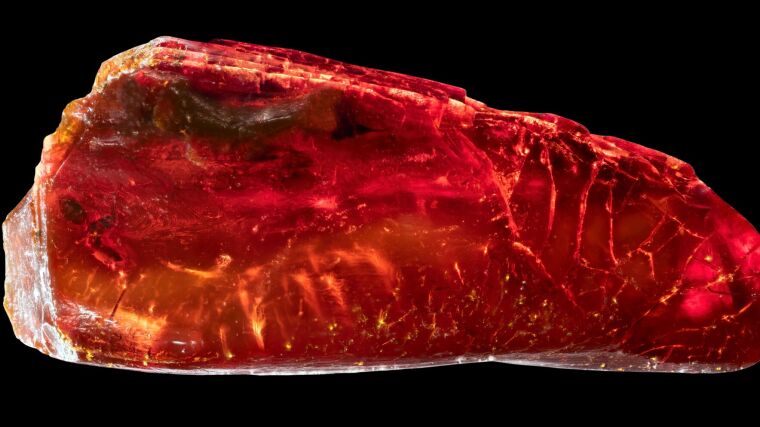
Even some 200 years after his death, Johann Wolfgang von Goethe’s scientific curiosity continues to yield new insights. This has now been demonstrated by biologists at Friedrich Schiller University Jena while closely examining the amber collection of the Weimar poet and polymath. In one of the pieces, they discovered a fossilized ant approximately 40 million years old which, thanks to its excellent state of preservation and extensive analyses, provides valuable information about the insect species. The Jena researchers report their findings together with experts from the Senckenberg Gesellschaft für Naturforschung and the Klassik Stiftung Weimar in the scientific journal »Scientific Reports«.
Goethe’s amber collection, housed by the Klassik Stiftung Weimar at the Goethe National Museum, comprises a total of 40 pieces originating from the Baltic region. In two of them, the Jena scientists discovered three fossil animal inclusions. The poet himself was likely unaware of the millions-of-years-old contents of these biological time capsules, as the animals are barely visible to the untrained eye in the unpolished stones. To identify them beyond doubt, the Jena team therefore employed modern imaging techniques. They scanned the promising amber pieces at the German Electron Synchrotron DESY in Hamburg using synchrotron micro-computed tomography, producing three-dimensional images of a fungus gnat, a black fly, and an ant.
The ant in particular attracted great interest among the Jena researchers. »The ant belongs to the extinct species †Ctenobethylus goepperti (Mayr, 1868), which is very common in amber,« explains Bernhard Bock from the Phyletisches Museum of the University of Jena. »Thanks to its excellent preservation and the extensive investigations, however, we were able to describe it in greater detail than ever before and gain new information about the species and its relationships.« In addition to fine hairs on the body of the worker ant, the researchers were able for the first time to look inside it and visualize endoskeletal structures in the head and thorax, revealing more about ant morphology.
»We have fully processed the specimen and, based on the newly acquired information, created a 3D reconstruction that is available online,« says Daniel Tröger from the University of Jena. »This model helps colleagues worldwide to identify and compare further fossils of this species.«
Based on similarities to the ant genus Liometopum, which today lives in North America or warmer regions of Europe, conclusions can be drawn about the lifestyle of these extinct ants. The ant from Goethe’s amber presumably built large nests in trees, which could also explain why the species is so frequently found in amber.
Johann Wolfgang von Goethe himself showed little interest in amber throughout his life—apart from its potential optical properties. For example, he ground lenses from the fossilized tree resin in order to observe specific color spectra for his theory of colors. Although systematic research into the material and the fossils it contains began in the mid-18th century, and early scientific publications can also be found in his library, the significance of these studies for his own fields of interest was not yet foreseeable.
»Goethe is regarded as the founder of morphology and would likely have been delighted to see how we were able to gain valuable insights in this field using entirely new methods,« says Bernhard Bock. »At the same time, the results demonstrate the value of such historical collections. It is truly fascinating that an object originating from his hand and his era—when this science was just beginning—can still enrich us so much today.«
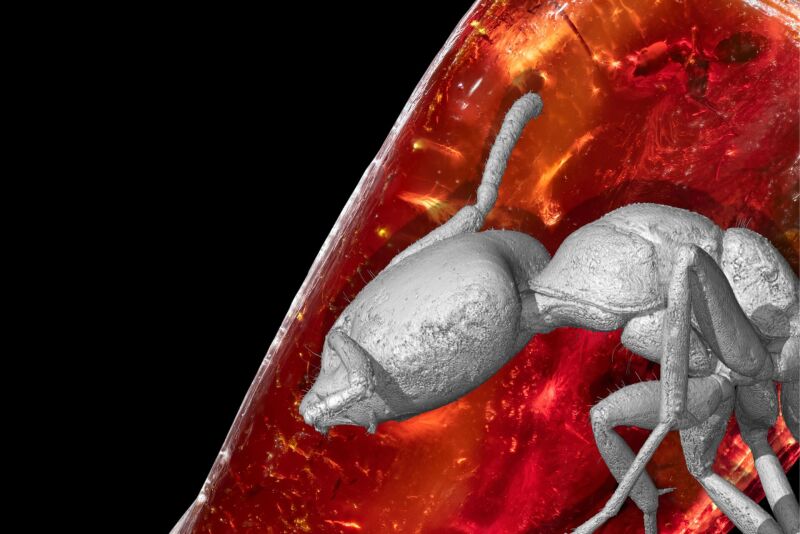
3D reconstruction of the ant and the fossil in the original amber behind it.
Picture: Bernhard Bock/Daniel TrögerOriginal publication:
Boudinot, B.E., Bock, B.L., Tröger, D. et al. Discovery of Goethe’s amber ant: its phylogenetic and evolutionary implications. Sci Rep (2026). https://doi.org/10.1038/s41598-026-36004-4External link
The 3D model is available online at: https://sketchfab.com/entomology_uni_jena/collections/goethe-amber-42b5252b3c5b478ca0afd3577ae6420aExternal link