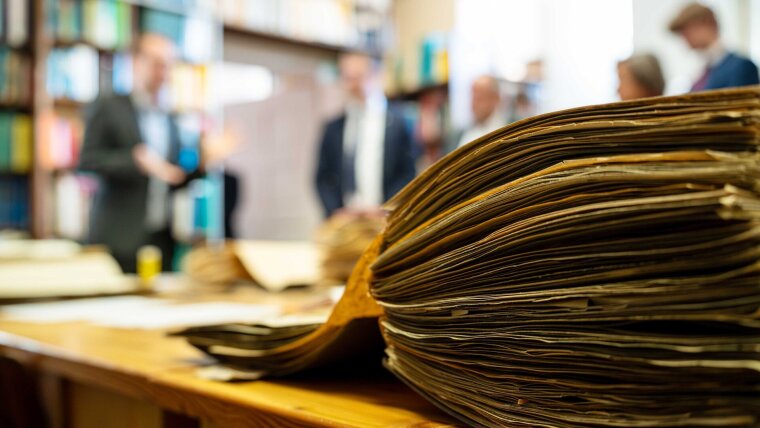
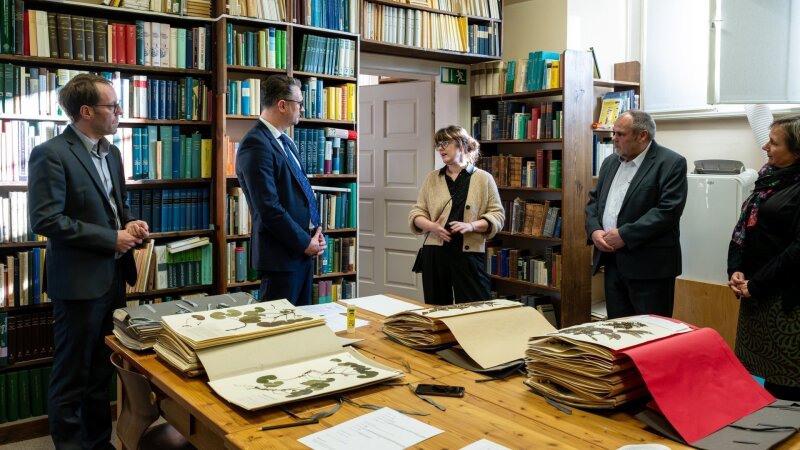
Today (15 January 2026), the Thuringian Minister for Education, Science and Culture, Christian Tischner, the Thuringian State Secretary for Science, Prof. Dr Steffen Teichert, the Director General of the Senckenberg Gesellschaft für Naturforschung, Prof. Dr Klement Tockner and the President of Friedrich Schiller University Jena, Prof. Dr Andreas Marx were given an insight into the BOTANICA digitization project. In the Thuringian University and State Library (ThULB), library director Dr Andreas Klinger and the head of the Senckenberg Institute for Plant Form and Function (SIP), Prof. Dr Christine Römermann, presented the project context. During the subsequent visit to the Herbarium Haussknecht, the participants discussed the content, objectives and perspectives of collection-based biodiversity research at the SIP Jena.
BOTANICA is a joint project of the ThULB and SIP Jena, integrated into the research location Jena: The aim is the complete digitization of the historical botanical book collection of the Herbarium Haussknecht Foundation. Around 12,500 titles from the 16th to the early 20th century will be captured using modern scanning technology, made searchable using text recognition (OCR) and made accessible online worldwide. The project is being funded by the Thuringian Ministry of Education, Science and Culture with 950,000 euros for the period from 2025 to 2028.
Digital access to a botanical memory spanning centuries
»Historical literature and plant records are archives that tell us a lot about biodiversity change over the last century. By digitizing and integrating the various data sources, research resources are created that enable new comparisons over long periods of time, for example to better understand biodiversity change«, says Prof. Dr Christine Römermann, Professor of Plant Biodiversity at the University of Jena and Head of SIP Jena.
Since the start of the project in autumn 2025, the team has procured and commissioned specialized scanning technology, including scanners with book-friendly mounts and a large-format scanner for plates and plans. BOTANICA relies on high-quality digitization with open standards and barrier-free access: The historical sources are not only provided as images, but are also prepared as citable, machine-readable and searchable resources. In this way, the project creates an additional basis for international biodiversity research, for example by systematically analysing historical locations, plant names and information on the people who collected them. For the University of Jena and its partner institutions, the project opens up new opportunities to integrate historical sources more closely into research, teaching and transfer.
»The achievements of the newly founded Senckenberg Institute here in Jena are impressive. I am very pleased that we have been able to support the Thuringian University and State Library with state funding of almost one million euros to digitize the historically significant book and journal holdings of the Herbarium Haussknecht«, emphasized Science Minister Christian Tischner. »In this way, we are not only making valuable knowledge available for international research, but also opening up this treasure to the general public for the first time.«
»BOTANICA opens up a botanical memory spanning centuries. We are transforming historical knowledge into an open, digital knowledge system so that it can be used worldwide: for research, for education and for a public that wants to understand how our environment is changing«, says Dr Andreas Christoph, BOTANICA project manager and responsible for digital culture and collection management at the ThULB.
Social participation as part of the workflow
A team from the Saale-Betreuungswerk of Lebenshilfe Jena is supporting the digitization process. The workflow, quality routines and the next steps were defined together. The collaboration combines professionalism with social participation and includes training and technical guidance.
»We work with a clear, reproducible process chain: conservation-friendly digitization, standardized quality controls, OCR and indexing according to established metadata standards. This makes the digitized material not only readable, but also systematically analysable and interoperable«, emphasizes project coordinator Dr Kathrin Polenz.
»The BOTANICA project impressively demonstrates that the ThULB, with its digitization expertise that has been systematically expanded over the years, is once again proving itself to be a powerful information infrastructure«, emphasizes Dr Andreas Klinger, Director of the ThULB.