The invisible worlds beneath our feet
A research team from the Cluster of Excellence »Balance of the Microverse« shows how microorganisms on rock surfaces shape groundwater
Published: | By: Juliane Seeber
Deep beneath the Earth’s surface, in the pores and crevices of rock, live huge communities of microorganisms. They are invisible to the naked eye—yet they play a central role in the quality of our groundwater and in global cycles of matter. A research team led by Dr. Martin Taubert from the Cluster of Excellence »Balance of the Microverse« at the University of Jena now shows: Life in the subsurface follows two fundamentally different strategies—with far-reaching consequences for environmental research and practice.
Previous insights into microbial communities in groundwater have been based primarily on more easily available samples of cells floating freely in the water. However, prior studies already indicated that this captures only a small part of the picture. In fact, the vast majority of microorganisms in the subsurface live as biofilms firmly attached to rock surfaces—they are up to a thousand times more abundant there than free-swimming cells.
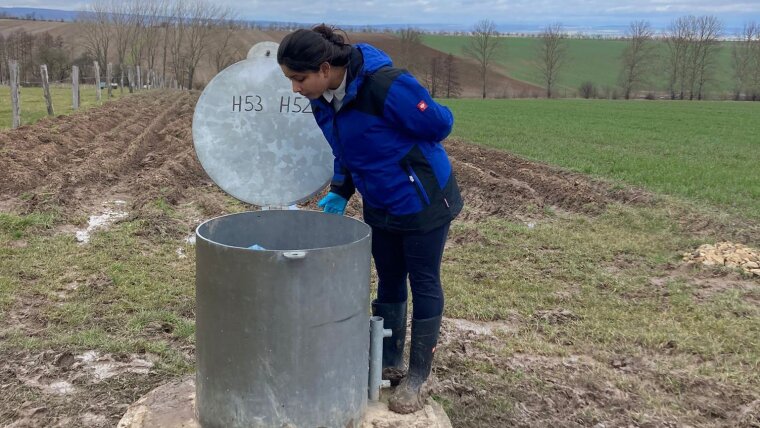
To better understand the hitherto barely investigated lifestyle of these »attached« microorganisms, the team analyzed microbial communities that had settled on carbonate rock in a natural aquifer in the Thuringian Hainich region. Using modern genome analyses, the researchers compared the attached communities with free-living communities from the same system.
The result is clear: Despite their close spatial contact and possible interactions, the microorganisms in the water and on the rock form two strongly contrasting ecological communities. Not only do the species differ greatly, but their capabilities are also fundamentally different.
»We found that the lifestyle of the microorganisms—attached to rock or floating free in the water—has a stronger influence on the structure of the community than environmental factors, such as the availability of oxygen,« explains Alisha Sharma, who conducted the study as part of her doctoral thesis.
The rock-bound microbes are highly specialized. They can generate energy from inorganic substances such as iron or sulfur and bind carbon dioxide in the process. In doing so, they actively contribute to carbon storage in the subsurface. The free-living microorganisms in the water, by contrast, are functionally significantly more restricted.
»If we ignore the community attached to rock, we overlook an important functional actor in the groundwater system,« explains Dr. Martin Taubert, a research group leader in the Cluster of Excellence. »These microorganisms make an important contribution to central chemical processes such as the carbon cycle.«
These findings have concrete practical relevance. Groundwater is one of the most important drinking water resources worldwide. A better understanding of microbial processes in the subsurface helps to evaluate the transformation of substances in the underground more realistically, for instance regarding the natural self-purification of groundwater or the long-term storage of carbon. Furthermore, the results suggest that groundwater ecosystems in carbonate rocks may bind significantly more carbon dioxide in the subsurface than previously assumed—an aspect relevant for climate models and assessments of natural carbon sinks.
The study exemplifies the research approach of the Cluster of Excellence »Balance of the Microverse.« The aim of the Cluster is to understand how microbial communities shape their environment—and how, conversely, environmental conditions influence microbial balance.
»Microorganisms keep many natural systems in balance without us noticing,« says Prof. Kirsten Küsel, Professor of Aquatic Geomicrobiology and Speaker of the Cluster of Excellence »Balance of the Microverse.« "By unlocking their hidden habitats, we better understand how stable—or vulnerable—these systems really are."
The work impressively shows that microbial life in the subsurface is not a passive background, but an active shaper of our environment—with significance extending far beyond the ground beneath our feet.
Original publication:
Sharma, A., Küsel, K., Wegner, CE. et al. Two worlds beneath: Distinct microbial strategies of the rock-attached and planktonic subsurface biosphere. Microbiome (2026). https://doi.org/10.1186/s40168-025-02325-1External link