Religious Studies: World Religions in the Past and Present
What exactly is a religion? How are its dynamics? And what are its views on peace, liberty and righteousness? If you are interested in these questions, this is the programme for you!
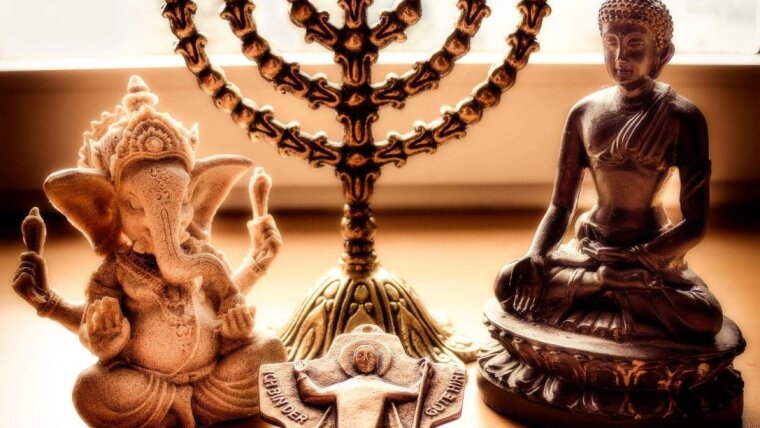
More than just gods, spirits and higher beings!
The world’s religions play a role in our everyday lives, sometimes through obvious symbols like crosses, kippahs and hijabs, but sometimes more inconspicuously through customs and ways of thinking.
The bachelor’s programme in ‘Religious Studies’ mainly focuses on the five major religions: Judaism, Christianity, Islam, Buddhism and Hinduism. You will explore what people believe(d) in and the extent to which cultures and societies are influenced by religion. However, you will also look at the world’s minor religions.
You definitely won’t get bored, as every religion has its own cosmologies and ideas on the role of mankind in the world, as well as its own ethical principles and philosophies on the meaning of life, earthly existence and the afterlife.
Of course, an important role is also played by various rituals, scriptures, buildings and paintings, and these will be examined in greater detail to identify similarities and differences between religions.
Religious studies is an interdisciplinary field that studies religious traditions of the past and present, identifying their historical development, emergence and passing with a range of qualitative and quantitative methods.
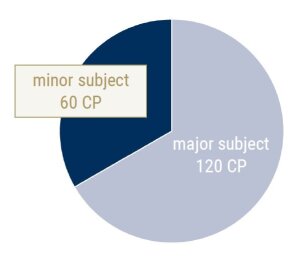
minor subject
Graphic: Sophie BartholomeThe bachelor's degree is the first professional qualification. The standard period of study is a total of six semesters, during which various forms of courses (e.g. seminars, lectures or exercises) are offered for the individual modules.
A multi-subject bachelor’s programme consists of a major subject with 120 credit points (CP for short; 1 CP = 30 hours for attendance, preparation and follow-up work, private study, assessed coursework and examinations) and a minor subject with 60 CP.
‘Religious Studies: World Religions in the Past and Present’ is a minor subject that can be combined with all major subjects at the University of Jena. It is open to members of all religions and denominations, as well as non-religious students.
The following table shows the possible structure of your course with ‘Religious Studies’ as your minor subject:
| Semester | Modules | |
| 1st | Introduction to Religious Studies (Lecture/Practical course, 5 CP) |
Introduction to the History and Literature of Ancient Israel in the Context of the Ancient Near East (10 CP) |
| 2nd | Introduction to Religious Studies (Seminar, 5 CP) |
|
| 3rd | Special History of Religions III: Islam (10 CP) | – |
| 4th | Special History of Religions: Region-Oriented History of Religion and Interreligious Relations (10 CP) | – |
| 5th | Expression and Mediation in World Religions (10 CP) | – |
| 6th | Special History of Religions VI: Buddhism (10 CP) | – |
Abbreviations: CP = credit points
More detailed information can be found in the module catalogue for the study programme [in German]External link.
Areas of employment for graduates
‘Religious Studies: World Religions in the Past and Present’ is a field of study open to members of all religions and denominations, as well as non-religious students.
A university entrance qualification, such as a general secondary school leaving certificate, is required for admission onto the study programme.
More information on university entrance qualifications can be found here.
The study programme is taught in German. You must therefore have a very good command of German at the start of the study programme.
Proficiency in English is required; another modern or classic foreign language is also recommended; students must submit evidence of their language skills (except German—see above) when registering the subject of their bachelor’s thesis at the latest.
Room 204
Fürstengraben 6
07743 Jena
Google Maps site planExternal link
Opening hours:
by arrangement
Fürstengraben 6
07743 Jena
Google Maps site planExternal link
Opening hours:
by arrangement
Bachstraße 18k
07743 Jena
Telephone hours:
Mondays and Fridays (9:00 – 11:00)
Wednesdays (13:00 – 15:00)
The ASPA is primarily responsible for students in the Faculty of Social and Behavioural Sciences, the Faculty of Arts and Humanities, and the Faculty of Theology.
Postal address:
Akademisches Studien- und Prüfungsamt
Fürstengraben 1
07743 Jena
University Main Building / SSZ
Fürstengraben 1
07743 Jena
Google Maps site planExternal link
Office hours:
We offer consultations in person, by telephone, and via Zoom. You can make an appointment by calling us on +49 3641 9-411111 (Mondays to Fridays from 9:00 to 11:00) or outside these office hours on +49 3641 9-411200. You can also use our remote help desk.
Consultation hours:
Mondays, Tuesdays, Thursdays and Fridays (9:00 to 12:20), Tuesdays (14:00 to 18:00), and Wednesdays and Thursdays (14:00 to 16:00).
Video chat: To the video chat – Zoom Videochat ZeitenMondays to Fridays (12:30 to 13:00) Password ZSB2020 Data protection informationpdf, 101 kb
University Main Building, Room E065
Fürstengraben 1
07743 Jena
Google Maps site planExternal link
Opening hours:
Information Desk (UHG; Room E0.65)
Mondays (10:00 – 12:00)
Tuesdays (13:00 – 15:00)
Wednesdays (10:00 – 12:00)
Thursdays (13:00 – 15:00)
Fridays (10:00 – 12:00)
You can also use our remote help desk at
www.uni-jena.de/service-ssz
or send us your enquiries by post.
Telephone hours:
Mondays to Fridays
(9:00 – 11:00)
Postal address:
Friedrich-Schiller-Universität Jena
Studierenden-Service-Zentrum
07737 Jena
University Main Building
Fürstengraben 1
07743 Jena
Google Maps site planExternal link