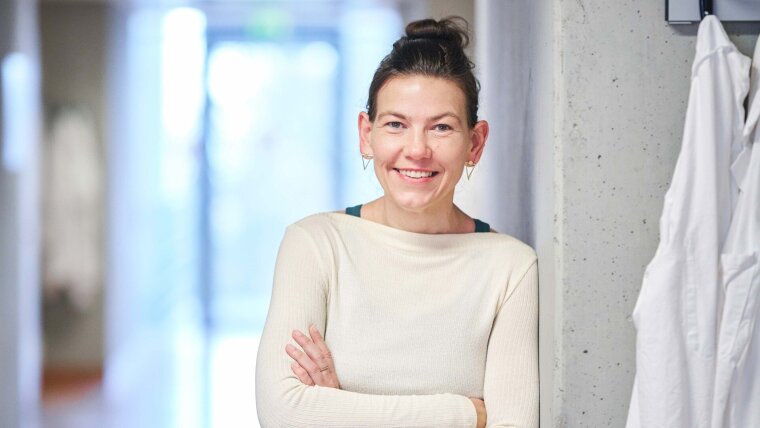
Prof. Dr. Ute Hellmich researches in the Cluster of Excellence “Balance of the Microverse”at the University of Jena.

Specific activation instead of continuous operation: How bacteria save energy and what this means for antibiotic resistances

Researchers in the Cluster of Excellence “Balance of the Microverse” at the University of Jena decipher a key mechanism of antibiotic resistance pumps
Prof. Dr. Ute Hellmich researches in the Cluster of Excellence “Balance of the Microverse”at the University of Jena.
Image: Anna Schroll
  • Life
  • Research

Published: | By: Marco Körner

Antibiotic resistance ranks among the greatest global health risks. A research team at Friedrich Schiller University Jena has now elucidated a previously unknown mechanism by which bacterial transport proteins precisely couple energy consumption to the expulsion of antibiotics. The findings provide new starting points for weakening resistance in a targeted manner. The study has been published in the journal Nature Communications.

How bacteria expel antibiotics from the cell

Many bacteria evade the effects of antibiotics by actively pumping them out of the cell. They do this with the aid of so-called multidrug efflux pumps, which can recognise and remove a wide variety of substances. One particularly important group is formed by ABC transporters, which use the energy-carrying molecule ATP to drive this process.

“These transporters are highly efficient molecular machines,” says Prof. Dr Ute Hellmich, Professor of Biomolecular NMR Spectroscopy at the University of Jena, who led the research project within the Excellence Cluster “Balance of the Microverse”. “They ensure that antibiotics cannot act in the place where they are actually meant to cause damage.”

Until now, however, it had been unclear how certain processes within these transporters are coordinated: the binding of the antibiotic on the one hand and the binding and consumption of ATP on the other – particularly as these two processes take place at sites that are spatially far apart, just as a furnace in the basement can heat a room on the third floor. “Consuming energy without transporting an antibiotic would be extremely inefficient for the cell,” explains Hellmich. “Conversely, there is no benefit in binding an antibiotic if transport is not triggered.”

A molecular “communication hinge”

In their current study, the researchers were able to show for the first time that the two processes are bidirectionally coupled. Crucial to this coupling is a small set of specific amino acids within the transport protein that functions like a molecular communication hinge. This hinge detects whether both ATP and an antibiotic are bound and then precisely coordinates energy consumption and transport.

“You can think of it as a kind of safety check,” says Hellmich. “Only when both signals are present at the same time does the pump switch into active mode. In this way, the cell prevents valuable energy from being wasted.”

New approaches to combating antibiotic resistance

When the researchers specifically alter this hinge through mutations, the two processes become uncoupled: ATP continues to be consumed, but the drug is no longer transported. The results therefore provide new mechanistic insights into the functioning of resistance pumps – and open potential avenues for the development of new antibiotics. “If it becomes possible to selectively disrupt this internal communication within the antibiotics pump, existing antibiotics could once again become more effective,” says Hellmich. “This is an exciting approach in the fight against multidrug-resistant pathogens.”

Information

Original publication:
Victor Hugo Pérez Carrillo, Margot Di Cesare, Dania Rose-Sperling, Waqas Javed, Hannes Neuweiler, Julien Marcoux, Cédric Orelle, Jean-Michel Jault, Ute A. Hellmich, „Bidirectional communication between nucleotide and substrate binding sites in a type IV multidrug ABC transporter“, Nature Communications, 2025, DOI: 10.1038/s41467-025-65037-yExternal link

Contact:

Ute Hellmich, Prof. Dr
Group Leader
Biostructural Interactions
Foto Ute Hellmich
Image: Anne Günther (University of Jena)
Humboldtstraße 10
07743 Jena Google Maps site planExternal link