Romeo is ready for action again
The Romeo ion accelerator at the Institute of Solid State Physics in Jena has been upgraded and is back in operation.
Published: | By: Stephan Laudien
The terminal of the »Romeo« ion accelerator at the Institute of Solid State Physics at Friedrich Schiller University Jena, located at Helmholtzweg 3, has been completely renovated and expanded. However, the implantation chamber installed in the adjoining room with its ten-metre-long beam pipe can continue to be used. According to solid state physicist Prof. Dr Carsten Ronning, the modernised technology allows for more efficient research and the irradiation of larger areas. »We can now also accelerate high-melting elements in particular, thus covering all elements of the periodic table,« says Ronning. This was made possible by a large-scale equipment application, half of whose financing, amounting to just under one million euros, is being provided by the federal government and half by the Free State of Thuringia.
In an ion accelerator such as »Romeo«, ions, i.e. electrically charged atoms, are accelerated with a high voltage of up to 400,000 volts and then fired into other materials. Because the foreign atoms are implanted into the materials in this way, the devices are also called implanters. This process has been used at the University of Jena since the 1950s, while ‘Romeo’ has been in operation for around 30 years. It was time to modernise the facility, says Carsten Ronning. The same company that manufactured the facility was commissioned to do the work.
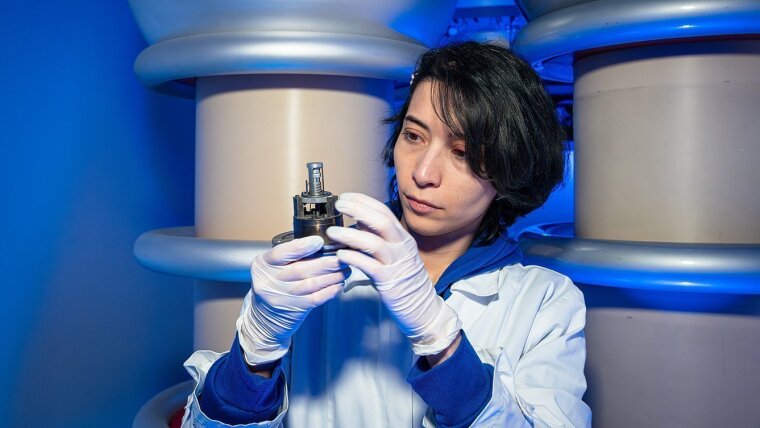
»Romeo« is used to manufacture optical amplifiers and lasers on photonic integrated chips. According to Prof. Ronning, there is a great need for experiments in photonics: »The system is in use every day!« This is ensured by real female power: technical employee Parisa Mirzaei operates »Romeo« on her own. Since the upgrade, many of the settings can be made via PC; previously, most of the work had to be done manually.
Because systems like Romeo are rather rare at university research institutions, cooperation partners of the Jena physicists will also benefit in the future. One example is the ERC ATHENS project, in which the universities of Karlsruhe and Lausanne are participating. Romeo is also used in the NOA—Nonlinear Optics down to Atomic scales—collaborative research centre and in the international graduate school META-ACTIVE. Because Romeo is an indispensable member of staff at the Institute of Solid State Physics, there will even be a small celebration tomorrow, Friday (09/01/26), to mark its recommissioning. Incidentally, the device owes its romantic-sounding name to a slightly older, second accelerator system at the institute. It is called »Julia«.