Criminal Law
What procedural obstacles can arise during a trial? What exactly is a penal order? And what are the possible sanctions for a given crime? If you are interested in these questions, this is the programme for you!

Let’s get one thing straight: we’re talking about more than just murder and manslaughter here. There are lots of different offences, cases and legal texts to keep students busy: from causing bodily harm, theft, forgery, to insults, a variety of prohibited acts can result in prosecution and punishment. This is the only way to safeguard life, property, security, the integrity of the state and the fundamental values of society.
In studying law at the University, you will learn how the German legal system and its laws work. If you specialize in Criminal Law, you will acquire basic knowledge and learn to solve simple legal cases on your own. Tackling legal issues is a brilliant way to sharpen your analytical thinking skills. By practising this way of thinking, you will be well prepared for the world of work and able to follow a broader range of career paths.
Multi-subject bachelor’s programme
Picture: Sophie BartholomeA bachelor’s degree is the first professional qualification that can be obtained at a university. The standard length of the programme is six semesters, and different types of courses are offered for each module (e.g. seminars, lectures or practical classes).
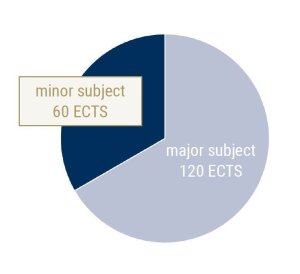
A multi-subject bachelor’s programme consists of a major subject worth 120 ECTS credits (1 ECTS credit = 30 hours for attendance, preparation and follow-up work, private study, assessed coursework and examinations) and a minor subject worth 60 ECTS credits.
This degree programme focuses on just one area of law, but it does include some modules from other areas of law to broaden your basic legal knowledge. You can choose one of three areas of law as your focus: in addition to Criminal Law, we offer Public Law and Civil Law as minor subjects.
The following table shows the possible structure of your degree programme with ‘Criminal Law’ as your minor subject:
| 1st semester | 2nd semester | 3rd semester | 4th semester | 5th semester | 6th semester | |
| Basic modules | Introduction to Legal Studies (3 ECTS) | Criminal Law – General Part (15 ECTS) | Criminal Law – Special Part (6 ECTS) | |||
| Advanced modules1 | Civil Code – General Part (9 ECTS) | Methodology of Criminal Casework (3 ECTS) | Basic Course in Public Law II (9 ECTS) | Practical Exercises in Criminal Law for Advanced Students (15 ECTS) | ||
| Fundamentals of Criminal Procedure (3 ECTS) | ||||||
| Supplementary modules2 | Supplementary module I – Fundamentals (3 ECTS) | Supplementary module II – Fundamentals (3 ECTS) | Supplementary module III – Fundamentals (3 ECTS) | |||
| Specialization modules | Seminar3 (9 ECTS) |
Abbreviations: ECTS = European Credit Transfer and Accumulation System (credit points)
1 The advanced modules include Practical Exercises in Criminal Law for Advanced Students, Fundamentals of Criminal Procedure, Fundamentals of Criminology, Civil Code – General Part, Methodology of Criminal Casework, and Basic Course in Public Law II.
2 This includes the following courses: Fundamentals of Medieval and Early Modern Legal History, Fundamentals of Roman Legal History and the History of European Private Law, Fundamentals of Modern Legal and Constitutional History, Fundamentals of Legal Philosophy and Argumentation Theory, and Fundamentals of Legal Theory, Legal Methodology, and Sociology of Law.
3 You can choose one of the following seminars: Criminology or International Law.
You can find more detailed information in the module catalogue for the degree programmeExternal link.
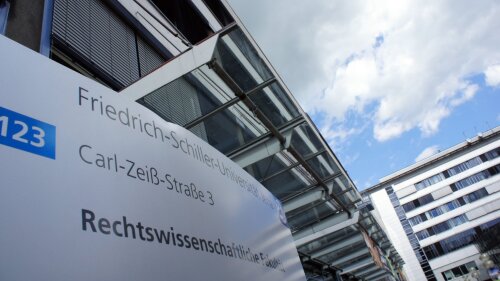
The Faculty of Law is based at Ernst-Abbe-Platz – in the heart of the city. A modern building complex houses the administration team and the various professorial chairs and institutes. Most of the lecture theatres and seminar rooms used by the Faculty of Law are also located here.
Career opportunities:

Graduates in conversation
Image: Designed by gpointstudio / freepik.comBy practising legal modes of thinking, familiarizing yourself with the concepts and content of the discipline of law, and learning how to solve legal cases by applying law to problem scenarios, you will broaden your range of career paths. However, graduating in the minor subject will not qualify you to work in purely legal fields. Your career opportunities will depend on your major subject.
To be accepted onto the degree programme, you will need a general university entrance qualification (Abitur or equivalent upper secondary school leaving certificate).
You can find more information about university entrance qualifications here.
Admission and language requirements for applicants of foreign nationality and without German Abitur: www.uni-jena.de/en/study-orientation-international
Room 2.50
Carl-Zeiß-Str. 3
07743 Jena
Google Maps site planExternal link
Carl-Zeiß-Str. 3
07743 Jena
Google Maps site planExternal link
Room 2.41
Carl-Zeiß-Str. 3
07743 Jena
Google Maps site planExternal link
University Main Building / SSZ
Fürstengraben 1
07743 Jena
Google Maps site planExternal link
Office hours:
We offer consultations in person, by telephone, and via Zoom. You can make an appointment by calling us on +49 3641 9-411111 (Mondays to Fridays from 9:00 to 11:00) or outside these office hours on +49 3641 9-411200. You can also use our remote help desk.
Consultation hours:
Mondays, Tuesdays, Thursdays and Fridays (9:00 to 12:20), Tuesdays (14:00 to 18:00), and Wednesdays and Thursdays (14:00 to 16:00).
Video chat: To the video chat – Zoom Videochat ZeitenMondays to Fridays (12:30 to 13:00) Password ZSB2020 Data protection informationpdf, 101 kb
University Main Building, Room E065
Fürstengraben 1
07743 Jena
Google Maps site planExternal link
Opening hours:
Information Desk (UHG; Room E0.65)
Mondays (10:00 – 12:00)
Tuesdays (13:00 – 15:00)
Wednesdays (10:00 – 12:00)
Thursdays (13:00 – 15:00)
Fridays (10:00 – 12:00)
You can also use our remote help desk at
www.uni-jena.de/service-ssz
or send us your enquiries by post.
Telephone hours:
Mondays to Fridays
(9:00 – 11:00)
Postal address:
Friedrich-Schiller-Universität Jena
Studierenden-Service-Zentrum
07737 Jena
University Main Building
Fürstengraben 1
07743 Jena
Google Maps site planExternal link