Programme content
Art is the daughter of freedom.
Friedrich Schiller
The world of art is full of secrets and mysteries. Is the Mona Lisa smiling or not? What about Rembrandt’s self-portraits? Was he the pioneering artist behind the modern selfie? How were films in post-war Germany influenced by the socio-political events of the time in terms of their camera work and the use of colour and music? And what message does Banksy want to convey through his street art? This is just a snippet of the topics covered in ‘Art History and Film Studies’ – there are so many more just waiting to be discussed.
This degree programme covers the history and theory of visual arts in the Western world – from the early Middle Ages to the present day – as well as film production in a global context. In addition to painting, sculpture, architecture, graphics and photography, you will also explore the realms of film and audiovisual media. This intriguing combination is unique in the German-speaking world.
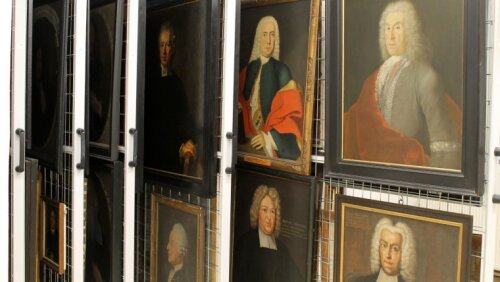
There is also lots of practical content. You will work on various projects with your fellow students and play a significant role in shaping exhibitions, publications and events. This will give you the opportunity to gain practical knowledge for your future career. Thanks to the University’s own collection of art and cultural items and the regular film screenings and lectures in the cinema, a special connection is established between research, teaching and professional practice.
Structure
Multi-subject bachelor’s programme
Picture: Sophie BartholomeA bachelor’s degree is the first professional qualification that can be obtained at a university. The standard length of the programme is six semesters, and different types of courses are offered for each module (e.g. seminars, lectures or tutorials).
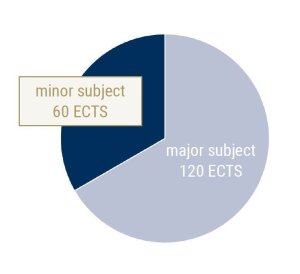
A multi-subject bachelor’s programme consists of a major subject worth 120 ECTS credits (1 ECTS credit = 30 hours for attendance, preparation and follow-up work, private study, assessed coursework and examinations) and a minor subject worth 60 ECTS credits.
How might your degree programme shape up?
The following table shows the possible structure of your degree programme with ‘Art History and Film Studies’ as your minor subject:
| Semester | Modules |
| 1 |
|
| 2 |
|
| 3 |
|
| 4 |
|
| 5 |
|
| 6 | – |
Abbreviations: ECTS = European Credit Transfer and Accumulation System (credit points)
* You can choose from the following modules: History of Medieval Art I; Film, Photography and Media Art I; History of Modern and Contemporary Art I; History of Early Modern and Modern Art I or Art Theory, Visual Studies, Media Studies and Aesthetics I.
You can find more detailed information in the module catalogue for the degree programme.External link
Why study in Jena?
- Excellent teaching: The Department of Art History and Film Studies at the University of Jena manages and catalogues digital images in a state-of-the-art media libraryExternal link, offering students full access to the most important national and international databases and enabling them to look up digital sources from the institute’s own collection.
- Thematic diversity: The Institute of Studies in Arts and Culture de covers the entire history of art – from the early Middle Ages to the present day – and explores a whole range of different art forms, including painting, sculpture, architecture, graphics, photography and film. This broad spectrum is also reflected in our researchExternal link.
- Interdisciplinary approach: The Film Aesthetics ColloquiumExternal link (Filmästhetische Kolloquium) at the University of Jena holds presentations and workshops on specific topics and discusses them with international experts. The aim is to work together on topics that fall within the crossroads between film studies and art history, as well as other related disciplines.
- A world of possibilities: Experience our international flair! Our University appeals to students and researchers from all over the world and helps to shape Jena’s character as a cosmopolitan city that is fit for the future – it’s the perfect place for international studentsmp4, 57 mb · de.
- Adventures abroad: You can easily realize your dream of spending a semester abroad. We have a global network of partner universities.
What can you do after your studies?
Career opportunities:
The skills acquired during your bachelor’s degree will open up career prospects in a wide variety of areas:
- Art education and conservation (museums, libraries, archives)
- Preservation of historical monuments
- Art shops and galleries
- Media (publishing, print media, television, radio)
- Adult education
- Public relations
Downloads and links for the degree programme
What are we looking for in prospective students?
- A special interest in the subjects of classical art history and new media
- Good communication skills (speaking and writing)
- An interest in attending national and international exhibitions
Admission requirements
-
University entrance qualification
A university entrance qualification, such as a general secondary school leaving certificate, is required for admission onto the study programme.
More information on university entrance qualifications can be found here.
-
Language requirements
Two languages; proof at the latest when registering for the Bachelor's thesis
Admission and language requirements for applicants of foreign nationality and without German Abitur: www.uni-jena.de/en/study-orientation-international
Contacts
Zenkerhaus, Room 223
Fürstengraben 18
07743 Jena
Google Maps site planExternal link
Zenkerhaus, Room 220
Fürstengraben 18
07743 Jena
Google Maps site planExternal link
Bachstraße 18k
07743 Jena
Telephone hours:
Mondays and Fridays (9:00 – 11:00)
Wednesdays (13:00 – 15:00)
The ASPA is primarily responsible for students in the Faculty of Social and Behavioural Sciences, the Faculty of Arts and Humanities, and the Faculty of Theology.
Postal address:
Akademisches Studien- und Prüfungsamt
Fürstengraben 1
07743 Jena
Frommansches Anwesen, Majorflügel, Room E 010
Fürstengraben 18
07743 Jena
Google Maps site planExternal link
University Main Building / SSZ
Fürstengraben 1
07743 Jena
Google Maps site planExternal link
Office hours:
We offer consultations in person, by telephone, and via Zoom. You can make an appointment by calling us on +49 3641 9-411111 (Mondays to Fridays from 9:00 to 11:00) or outside these office hours on +49 3641 9-411200. You can also use our remote help desk.
Consultation hours:
Mondays, Tuesdays, Thursdays and Fridays (9:00 to 12:20), Tuesdays (14:00 to 18:00), and Wednesdays and Thursdays (14:00 to 16:00).
Video chat: To the video chat – Zoom Videochat ZeitenMondays to Fridays (12:30 to 13:00) Password ZSB2020 Data protection informationpdf, 101 kb
University Main Building, Room E065
Fürstengraben 1
07743 Jena
Google Maps site planExternal link
Opening hours:
Information Desk (UHG; Room E0.65)
Mondays (10:00 – 12:00)
Tuesdays (13:00 – 15:00)
Wednesdays (10:00 – 12:00)
Thursdays (13:00 – 15:00)
Fridays (10:00 – 12:00)
You can also use our remote help desk at
www.uni-jena.de/service-ssz
or send us your enquiries by post.
Telephone hours:
Mondays to Fridays
(9:00 – 11:00)
Postal address:
Friedrich-Schiller-Universität Jena
Studierenden-Service-Zentrum
07737 Jena