History of Science

How and in what historical contexts did groundbreaking discoveries take place? How do cultural and political developments shape our knowledge of nature and mankind? If you are interested in these questions, then you are right here!
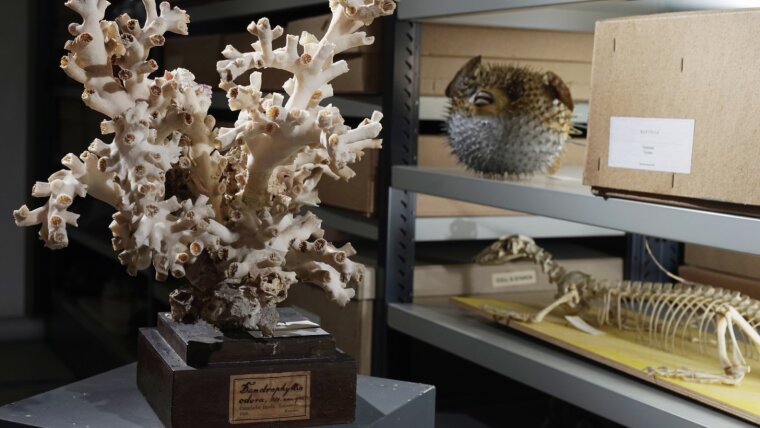
The naturalist Ernst Haeckel brought this coral from Spain to Germany in 1866.

Image: Jan-Peter Kasper (University of Jena)
The naturalist Ernst Haeckel brought this coral from Spain to Germany in 1866.
This page has been machine translated.

Key facts

Degree
Bachelor of Arts
Supplement to degree
minor in a multi-subject bachelor’s programme
Admission restriction
without admission restriction (without NC)
Duration
6 Semesters
Credits/ECTS
60
Teaching language
German
Tuition fee
None
Semester contribution
€ 333,05
Start of studies
Winter semester
Part-time possible
Yes
Institutions
Faculty of Biological Sciences
Institute of Zoology and Evolutionary Research

Application & Deadlines

Programme content

The Bachelor's supplementary subject provides basic knowledge about science in the past and present. You will become familiar with a variety of historical, theoretical and methodological approaches that will enable you to investigate complex questions and problems relating to the relationship between science, technology and society.

Structure

Multi-subject bachelor’s programme

Picture: Sophie Bartholome

The Bachelor's degree is the first professional qualification. The standard period of study|regular programme length is six semesters in total, during which various forms of courses (e.g. seminars, lectures or tutorials) are offered for the individual modules.

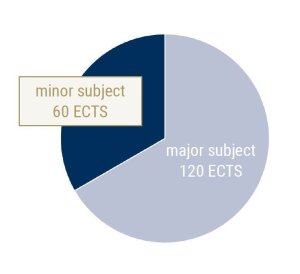
A multi-subject Bachelor's degree consists of a major subject with 120 credit points (abbreviation: LP / 1 LP = 30 hours of attendance, preparation and follow-up work|follow-up activity, learning and assessed coursework and examinations) and a supplementary subject with 60 LP.

How might your degree programme shape up?

The following table shows you an example of a possible programme structure for the supplementary subject »History of Natural Sciences«:

Semester Modules
1. to 2.
  • History of Natural Sciences I (10 CP)
  • History of Natural Sciences II (10 CP)
  • Introductory seminar »Introduction to the study of the history of science« (5 CP)
3. to 4.
  • History of Natural Sciences III (10 CP)
  • History of Natural Sciences IV (10 CP)
  • Introductory seminar »Archives and Writing« (5 CP)
5. to 6.
  • Seminar on special issues in the history of science* (5 CP)
  • Practical module*( 5 CP)
  • Reading course »Classical texts in the history of science«*( 5 CP)

Abbreviations: LP = credit points (ECTS)|ECTS credits

*Elective area: The programme comprises three compulsory elective modules.

More detailed information can be found in the module catalogue for the degree programmeExternal link.

Why study in Jena?

  • Teaching key skills: We place great emphasis on teaching general key skills, in particular the handling of academic texts as well as historical sources and the writing of term papers.
  • Excellent supervision: At the Chair of History and Philosophy of Science, which is based in the Villa Medusa, there is a personal working atmosphere.
  • Individual support: Small student numbers enable individual support for students and an intensive exchange between students and lecturers. 

What can you do after your studies?

Career opportunities:

The Bachelor's supplementary subject qualifies you for a wide range of activities outside the university, which particularly require interdisciplinary skills and reflection on knowledge and science:

  • Science journalism & science communication
  • Public,cultural & media relations
  • Museum & archives
  • Librarianship & publishing
  • Consulting activities in companies & foundations Science management in universities & research institutions. 

Postgraduate master’s programmes at our University

All degree programmes

What are we looking for in prospective students?

  • Interest in and understanding of the natural sciences and humanities
  • Readiness to read

Admission requirements

  • University entrance qualification

    A university entrance qualification, such as a general secondary school leaving certificate, is required for admission onto the study programme.

    More information on university entrance qualifications can be found here.

  • Language requirements

    English or another modern foreign language as well as basic knowledge of another academic language; proof by the time of registration for the Bachelor's thesis at the latest

Additional application documents for international students

  • CV

    Please submit an up-to-date and complete CV in tabular form. Please provide full details regarding your schooling and academic education to date. You can find more information hereExternal link

  • University entrance qualification certificate

    Please upload the school certificate confirming your university entrance qualification to our application portal. You can find more information hereExternal link

  • University degree certificate / previous periods of study

    Please upload transcripts of records for all previous periods of study and degrees, as well as, if applicable, your degree certificate, to the portal.

  • Proof of German proficiency

    Proof of sufficient German proficiency must be provided for all German-language degree programmes. The following certificates are recognized as proof of proficiency by Friedrich Schiller University Jena:

    • German Language Test for Admission to Higher Education, at least level 2 (DSH-2)
    • Goethe Certificate, C2 (GDS)
    • German Language Diploma, Level II of the Standing Conference of the Ministers of Education and Cultural Affairs (DSD II)
    • TestDaF, at least TDN 4 in all four parts of the examination
    • Telc German C1 University certificate (at least with the grade “satisfactory”)
    • German exam as part of the assessment test at a Studienkolleg

    Please note: We strongly recommend that you submit the required proof of German proficiency at the time of your application.

    If you do not yet have the required language certificate, you may apply for our DSH course starting from German level B1. This course ensures optimal language preparation and also gives you the opportunity to get to know Jena while benefiting from student status.

  • Translation of international application documents

    A translation into German or English must be submitted for every application document that was not originally issued in German or English. These translations must be prepared by an authorized translation office.

  • APS certificate

    Applicants with university degrees from India, Vietnam, or the People’s Republic of China must submit an APS certificate.

  • University entrance examination

    Applicants from the following countries must provide proof of their university entrance examination:

    • Iran (university entrance examination or proof of a foundation year if the school-leaving certificate was obtained before 2019)
    • Republic of Korea/South Korea (Scholastic Ability Test)
    • China (GaoKao)

Contacts

Academic Advisory Service - Dr. Florence Vienne

Opening hours:
nach Vereinbarung

Academic Office for Student Affairs and Examinations (ASPA)

Bachstraße 18k
07743 Jena

Support & Help
To Service-Desk
Link to download vCard
vCard
Further link
More information

Telephone hours:
Mondays and Fridays (9:00 – 11:00)
Wednesdays (13:00 – 15:00)

The ASPA is primarily responsible for students in the Faculty of Social and Behavioural Sciences, the Faculty of Arts and Humanities, and the Faculty of Theology.

Postal address:
Akademisches Studien- und Prüfungsamt
Fürstengraben 1
07743 Jena

Student Council for History of Natural Sciences

Berggasse 7
07743 Jena Google Maps site planExternal link

Link to download vCard
vCard

Central Student Advisory Service

University Main Building / SSZ
Fürstengraben 1
07743 Jena Google Maps site planExternal link

Support & Help
To Service-Desk
Mobile phone
+49 3641 9-411111
Link to download vCard
vCard

Office hours:
You can make an appointment by calling us on +49 3641 9-411111 (Mondays to Fridays from 9:00 to 11:00) or outside these office hours on +49 3641 9-411200. You can also use our remote help desk.

Consultation hours:
Mondays, Tuesdays, Thursdays and Fridays (9:00 to 12:20), Tuesdays (14:00 to 18:00), and Wednesdays and Thursdays (14:00 to 16:00).

Video chat: To the video chat – Zoom Videochat ZeitenMondays to Fridays (12:30 to 13:00) Password ZSB2020 Data protection informationpdf, 101 kb

Student Service Centre

University Main Building, Room E065
Fürstengraben 1
07743 Jena Google Maps site planExternal link

Support & Help
To Service-Desk
Link to download vCard
vCard
Further link
More information

Opening hours:
ON 27 AND 28 AUGUST, THE INFORMATION DESK WILL BE CLOSED!!

Information Desk (UHG; Room E0.65)
Mondays (10:00 – 12:00)
Tuesdays (13:00 – 15:00)
Wednesdays (10:00 – 12:00)
Thursdays (13:00 – 15:00)
Fridays (10:00 – 12:00)

You can also use our remote help desk at
www.uni-jena.de/service-ssz
or send us your enquiries by post.

Telephone hours:
Mondays to Fridays
(9:00 – 11:00)

Postal address:
Friedrich-Schiller-Universität Jena
Studierenden-Service-Zentrum
07737 Jena

International Office - International students

University Main Building
Fürstengraben 1
07743 Jena Google Maps site planExternal link

Link to download vCard
vCard