Programme content
The Middle Ages left a monumental legacy of handwritten books. The surviving manuscripts range from collections of letters, vitae, historical accounts and speeches to poems and epics. The invention of the printing press at the dawn of the modern era gave rise to a new golden age of Latin literature. All the great writers of the time – from scientists and poets to politicians and clerics – expressed their thoughts predominantly in Latin.
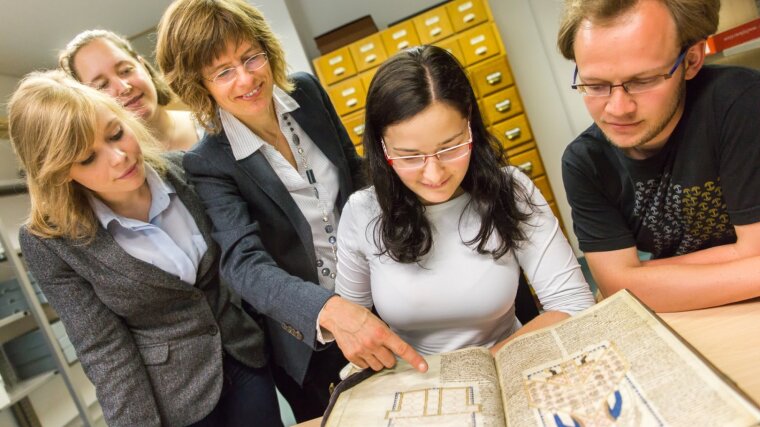
A significant portion of the Latin texts are yet to be read or translated – let alone commented on – to make the content more accessible to the modern reader. That’s what makes studying medieval and neo-Latin philology so exciting! And these are exactly the kind of texts you will be examining alongside your teachers during your studies. You will learn how to read and deal with medieval Latin manuscripts, how to determine when and where they were written, and how to explore unchartered territory.
A range of theoretical lectures and seminars will familiarize you with the literary and cultural history of the Middle Ages and the modern era. You will learn about forms of literary expression, intellectual views, themes and styles from antiquity to the time when vernacular literature gained a solid foothold in Europe. In the courses, you will experience how the transition between the two great epochs – the Middle Ages and the modern era – took place in the medium of the Latin language and how it still shapes our lives and thoughts to this day.
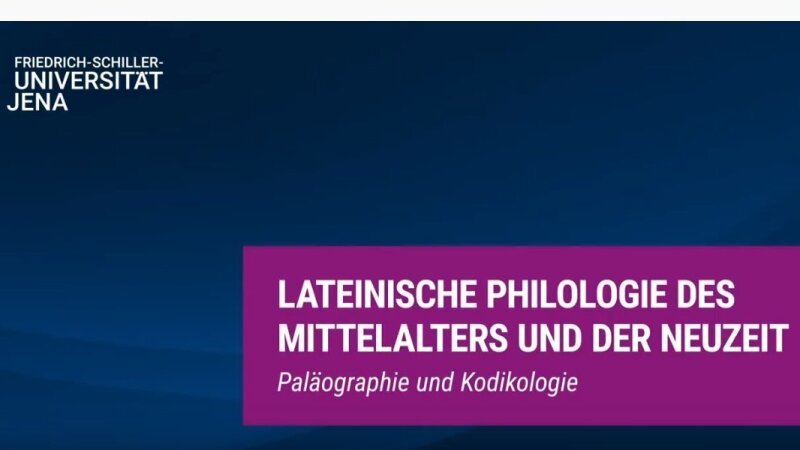
How do you read manuscripts and handwritten books? The following video gives you an insight into the world of palaeography with a few small excerpts and a short reading exercise:
How do you read manuscripts and handwritten books? Using short text examples and a short reading exercise, students and interested parties are introduced to the world of paleography.
Screenshot: Sophie BartholomeStructure
Multi-subject bachelor’s programme
Picture: Sophie BartholomeA bachelor’s degree is the first professional qualification that can be obtained at a university. The standard length of the programme is six semesters, and different types of courses are offered for each module (e.g. seminars, lectures or tutorials).
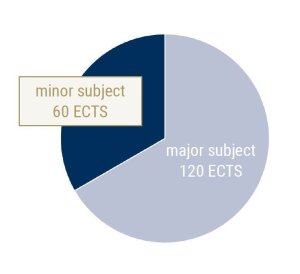
A multi-subject bachelor’s programme consists of a major subject worth 120 ECTS credits (1 ECTS credit = 30 hours for attendance, preparation and follow-up work, private study, assessed coursework and examinations) and a minor subject worth 60 ECTS credits. The degree programme consists of six compulsory modules.
How might your degree programme shape up?
The following table shows the possible structure of your degree programme with ‘Medieval and New Latin’ as your minor subject:
| Semester | Modules |
| 1 to 2 |
|
| 3 to 4 |
|
| 5 to 6 |
|
Abbreviation: ECTS = European Credit Transfer and Accumulation System (credit points)
You can find more detailed information in the module catalogue for the degree programmeExternal link.
Why study in Jena?
- Exclusive degree programme: Very few universities in Germany offer you the opportunity to study Middle or New Latin. In Jena, you can study both subjects together and explore 1,500 years of Latin literature.
- Flexible combinations: As a minor subject, Medieval and New Latin can be combined with numerous different major subjects such as Classical Studies and Ancient History de, History de, Indo-European Studies de or languages, allowing you to create meaningful connections between disciplines.
- Focus on research: Students have the opportunity to participate in research projects and trips such as the Papebroch research group de.
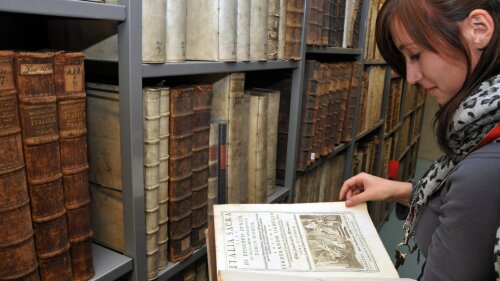
- Books and more: The central university library has the latest specialist literature and houses a number of valuable old holdings such as the Bibliotheca ElectoralisExternal link collection, which contains over 1,400 early modern prints and around 190 manuscripts.
- Excellent support: Small courses allow students to interact closely with one another and their teachers.
- Cooperation with related disciplines: As part of an interdisciplinary network, our institute collaborates with other disciplines within Classical studies as well as neighbouring disciplines such as German Studies, Romance Studies and History.
- A world of possibilities: Experience our international flair! Our University appeals to students and researchers from all over the world and helps to shape Jena’s character as a cosmopolitan city that is fit for the future – it’s the perfect place for international studentsmp4, 57 mb · de.
- Adventures abroad: You can easily realize your dream of spending a semester abroad. We have a global network of partner universities.
What can you do after your studies?
Career opportunities:
Knowledge of Latin language and literature is a valuable additional qualification for a large number of humanities subjects. Those graduating from the bachelor’s programme are particularly qualified for work
- at universities and other academic institutions (e.g. in the field of digital humanities spanning various disciplines and time periods),
- in museums and publishing houses, and
- in archives and libraries (in the field of manuscripts and old prints).
Downloads and links for the degree programme
What are we looking for in prospective students?
- An interest in the Middle Ages and the early modern period
- A passion for languages and books
- Curiosity about research topics that remain unsolved
- An interest in puzzling over untranslated pieces of text or almost illegible manuscripts
Admission requirements
-
University entrance qualification
A university entrance qualification, such as a general secondary school leaving certificate, is required for admission onto the study programme.
More information on university entrance qualifications can be found here.
-
Language requirements
Latin proficiency certificate (Latinum) and knowledge of a modern foreign language; this evidence must have been submitted by the time you register your dissertation topic.
Admission and language requirements for applicants of foreign nationality and without German Abitur: www.uni-jena.de/en/study-orientation-international
Contacts
Room 205
Fürstengraben 25
07743 Jena
Google Maps site planExternal link
Opening hours:
By appointment
Bachstraße 18k
07743 Jena
Telephone hours:
Mondays and Fridays (9:00 – 11:00)
Wednesdays (13:00 – 15:00)
The ASPA is primarily responsible for students in the Faculty of Social and Behavioural Sciences, the Faculty of Arts and Humanities, and the Faculty of Theology.
Postal address:
Akademisches Studien- und Prüfungsamt
Fürstengraben 1
07743 Jena
University Main Building / SSZ
Fürstengraben 1
07743 Jena
Google Maps site planExternal link
Office hours:
We offer consultations in person, by telephone, and via Zoom. You can make an appointment by calling us on +49 3641 9-411111 (Mondays to Fridays from 9:00 to 11:00) or outside these office hours on +49 3641 9-411200. You can also use our remote help desk.
Consultation hours:
Mondays, Tuesdays, Thursdays and Fridays (9:00 to 12:20), Tuesdays (14:00 to 18:00), and Wednesdays and Thursdays (14:00 to 16:00).
Video chat: To the video chat – Zoom Videochat ZeitenMondays to Fridays (12:30 to 13:00) Password ZSB2020 Data protection informationpdf, 101 kb
University Main Building, Room E065
Fürstengraben 1
07743 Jena
Google Maps site planExternal link
Opening hours:
Information Desk (UHG; Room E0.65)
Mondays (10:00 – 12:00)
Tuesdays (13:00 – 15:00)
Wednesdays (10:00 – 12:00)
Thursdays (13:00 – 15:00)
Fridays (10:00 – 12:00)
You can also use our remote help desk at
www.uni-jena.de/service-ssz
or send us your enquiries by post.
Telephone hours:
Mondays to Fridays
(9:00 – 11:00)
Postal address:
Friedrich-Schiller-Universität Jena
Studierenden-Service-Zentrum
07737 Jena