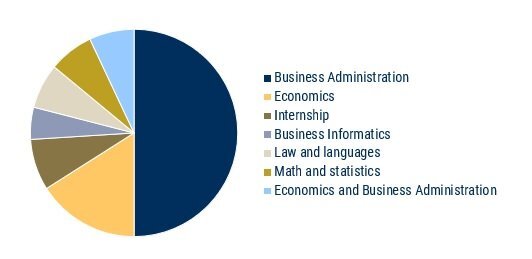
How might your degree programme shape up?
| 1st semester |
2nd semester |
3rd semester |
4th semester |
5th semester |
6th semester |
Accounting (3 ECTS) |
Statistics (6 ECTS) |
Foundations of Marketing Management (6 ECTS) |
Investment, Financing and the Capital Market (6 ECTS) |
Integrated Information Processing (4 ECTS) |
Choice of specialization module* (6 ECTS) |
Financial Accounting and Controlling (6 ECTS) |
Organization, Leadership and Human Resource Management (6 ECTS) |
Planning and Decision-Making (6 ECTS) |
Management (6 ECTS) |
Foreign Languages (6 ECTS) |
Operations Management (6 ECTS) |
Taxation / Auditing (6 ECTS) |
Foundations and Perspectives of Economic Studies (3 ECTS) |
Macroeconomics (5 ECTS) |
Choice of specialization module* (6 ECTS) |
Bachelor’s dissertation (10 ECTS) |
Introduction to Economics (5 ECTS) |
Law A (4 ECTS) |
Law B (2 ECTS) |
Choice of specialization module* (6 ECTS) |
|
Microeconomics (5 ECTS) |
Introduction to Business Information Systems (6 ECTS) |
Finance (5 ECTS) |
Choice of specialization module* (6 ECTS) |
|
Mathematics A (3 ECTS) |
Mathematics B (3 ECTS) |
Empirical and Experimental Research in Economics (6 ECTS) |
|
Seminar for specialization module* (6 ECTS) |
|
| Vocational learning content (14 ECTS) |
Abbreviations: ECTS = European Credit Transfer and Accumulation System (credit points)
* You have to take six elective specialization modules. To do this, you will have to choose one of the following focus areas: Finance, Accounting & Taxation; Decision and Risk; International Management; Strategy, Management and Marketing; Supply Chain Management; or Business Information Systems. You have to choose at least four modules from this area; the other two modules can be combined as you wish.
What can you do after your studies?
Areas of employment for graduates
Depending on your chosen area of specialization, you can look forward to a wide range of career opportunities in various fields of business and economics:
- in commerce (e.g. accounting, controlling, management, human resources, production, logistics, taxes)
- in all areas of the private sector with a high demand for analytical skills (e.g. consulting firms, banks, insurance companies)
- in the public sector (e.g. administration, statistical offices, authorities and ministries, associations, chambers)
- in the IT sector (e.g. as a business analyst)
- in science and research (e.g. as a teaching associate at a university, generally with a master’s degree)
- as a teacher of economics, business administration or law at vocational colleges
- in a newspaper’s editorial department for business and economics
What are we looking for in prospective students?
- An interest in current affairs in business and economics
- Good knowledge of German (language of instruction: German) and a good grasp of mathematical concepts
- Good organization skills and time management