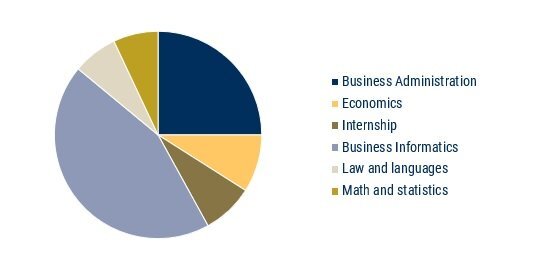
How might your degree programme shape up?
| 1st semester |
2nd semester |
3rd semester |
4th semester |
5th semester |
6th semester |
Operations Management (6 ECTS) |
Microeconomics or Macroeconomics (5 ECTS) |
Choice of specialization module* e.g. Data Science in R (6 ECTS) |
Organization, Leadership and Human Resource Management or Taxation / Auditing (6 ECTS) |
Choice of specialization module* e.g. Computer-Aided Planning and Optimization (6 ECTS) |
E-Commerce (6 ECTS) |
Accounting (3 ECTS) |
Statistics (6 ECTS) |
Foundations of Marketing Management (6 ECTS) |
Investment, Financing and the Capital Market (6 ECTS) |
Choice of specialization module* e.g. Web Programming (6 ECTS) |
Bachelor’s dissertation (10 ECTS) |
Introduction to Economics (5 ECTS) |
Introduction to Business Information Systems (6 ECTS) |
Planning and Decision-Making (6 ECTS) |
Choice of specialization module* e.g. Management Science (6 ECTS) |
Integrated Information Processing (4 ECTS) |
|
Data, Information and Knowledge Management (6 ECTS) |
Choice of specialization module* e.g. Operations Management (6 ECTS) |
Financial Accounting and Controlling (6 ECTS) |
Choice of specialization module* e.g. Software and IT Management (6 ECTS) |
Empirical and Experimental Research in Economics (6 ECTS) |
|
Introduction to Programming (6 ECTS) |
Management (6 ECTS) |
Foreign Languages for Economists (6 ECTS) |
Seminar (6 ECTS) |
|
Mathematics for Economists (6 ECTS) |
|
Law for Economists (6 ECTS) |
|
| Vocational learning content (15 ECTS) |
Abbreviations: ECTS = European Credit Transfer and Accumulation System (credit points)
* When choosing your elective modules, you have to take at least 36 ECTS in specialization modules (e.g. Current Issues in Business Information Systems; Software and IT Management; or Computer-Aided Planning and Optimization). Alternatively, you can choose individual modules from the Faculty of Mathematics and Computer Science.
What can you do after your studies?
Areas of employment for graduates
- In commerce (e.g. in accounting, controlling, management, production, logistics, taxes)
- in the promising IT sector (e.g. as a software developer or IT consultant)
- in all areas of the private sector with a high demand for analytical skills (e.g. consulting firms, banks, insurance companies)
- in the public sector (e.g. administration, statistical offices, authorities and ministries, associations, chambers)
- in science and research (e.g. as a teaching associate at a university, generally with a master’s degree)
What are we looking for in prospective students?
- An interest in current affairs in business and economics
- Good knowledge of German (language of instruction: German) and a good grasp of mathematical concepts
- A general interest in computer science
- Good organization skills and time management