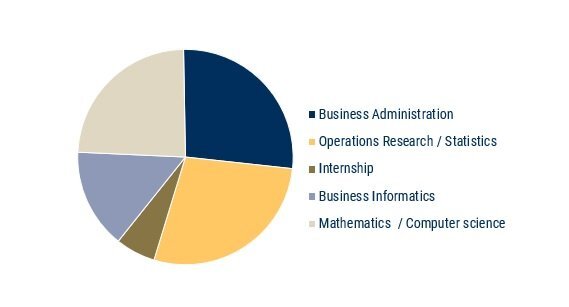
How might your degree programme shape up?
The following table shows the possible structure of your course if you choose to specialize in ‘Optimization’:
| 1st semester |
2nd semester |
3rd semester |
4th semester |
5th semester |
6th semester |
Linear Algebra (6 ECTS) |
Foundations of Analysis (6 ECTS) |
Applied Statistics1 (6 ECTS) |
Operations Management1 (6 ECTS) |
Elective module 1: Business2 (6 ECTS)
|
Elective module 3: Business2 (6 ECTS) |
Operations Management (6 ECTS) |
Statistics (6 ECTS) |
Integrated Information Processing1 (4 ECTS) |
Algorithms and Data Structures1 (9 ECTS) |
Elective module 2: Business2 (6 ECTS) |
Bachelor’s dissertation (10 ECTS)
|
Introduction to Programming (6 ECTS) |
Management Science (6 ECTS) |
Databases and Information Systems1 (5 ECTS) |
Introduction to Optimization A (6 ECTS) |
Optimization Project (3 to 6 ECTS, as required) |
Introduction to Optimization B3 (6 ECTS) |
Planning and Decision-Making1 (6 ECTS) |
Introduction to Business Information Systems (6 ECTS) |
Linear Optimization (9 ECTS) |
Computer-Aided Planning and Optimization3 (6 ECTS) |
Discrete Modelling – Programming with Python II3 (5 ECTS) |
|
Data, Information and Knowledge Management1 (6 ECTS) |
Foundations of Algorithms – Programming with Python I1 (5 ECTS) |
Predictability and Complexity3 (6 ECTS) |
Project Management ASQ3 (3 ECTS) |
Seminar: Operations Management3 (6 ECTS) |
|
| Vocational learning content (10 ECTS) |
Abbreviations: ECTS = European Credit Transfer and Accumulation System (credit points)
1 You must choose at least 44 credit points from the first group of required elective modules. You can choose any combination of modules.
2 You must choose at least 12 credit points from the second group of required elective modules. Here you can take all foundational and specialization modules listed in the module catalogue for Economics and Business Administration (B.Sc.)External link to complement your studies as you wish.
3 When choosing required elective modules for your focus area, you have to take at least 33 credit points and at least one of the following seminars: Operations Management; Analysis of Business Decisions; or Business Information Systems.
What can you do after your studies?
Areas of employment for graduates
- in the IT sector (e.g. as a business analyst, data analyst, software developer or IT consultant)
- in all areas of the private sector with a high demand for analytical skills (e.g. consulting firms, banks, insurance companies)
- in commerce (e.g. logistics, production, controlling, management)
- in the public sector (e.g. administration, statistical offices, authorities and ministries, associations, chambers)
- in science and research (e.g. as a teaching associate at a university, generally with a master’s degree)
What are we looking for in prospective students?
- An interest in business affairs involving overlapping methods from the areas of business administration, mathematics and computer science
- The ability and willingness to think analytically and logically
- Good knowledge of German (language of instruction: German)
- Good organization skills and time management