Programme content
Do you like dealing with people? Are you passionate about business issues? Do you enjoy teaching? Great! Our bachelor’s degree in ‘Business and Economics Education Studies’ would be a good choice for you. While business education specialists mainly plan and hold lessons in schools and vocational colleges, they sometimes also work in training departments at companies and in other areas of adult education. As economic issues are so complex, they need to be conveyed by specially trained staff in way that is appropriate for the target audience.
If you study Business and Economics Education Studies at the Friedrich Schiller University Jena, you can specialize in one of two focus areas. In the second focus, you will primarily train to become a teacher at a vocational college in business and economics plus another unrelated subject. If you would like to practise that profession, however, you will need the relevant master’s degree. You can choose from the following teaching subjects outside of economics and business administration:
- Mathematics
- German, English, French, Spanish
- Ethics
- Protestant Theology in Religious Education
- Computer Science
- Social Studies
- Sports Science
By contrast, most of the content covered in the first focus is related to professional life and learning, as well as the structure of the vocational education system. The common features of both focus areas are the traditional fields of business administration, economics and business information systems. The following table highlights the differences between each discipline:
| Sub-area | Content |
| Business Administration | examines the economic activities of companies |
| Economics | examines the economic systems of states or larger entities, such as the EU |
| Business Information Systems | examines the use of computers to optimize workflows |
Digital discovery tour with free app: Would you like to solve some fun puzzles and learn more about studying at the Faculty of Economics and Business Administration? Click here for our interactive discovery tour app.
Structure
Our bachelor’s programme is the first degree qualifying graduates to work in their profession. The standard length of the study programme is six semesters, and different types of courses are offered for each module (e.g. seminars, lectures or exercises).
In this single-subject Bachelor’s programme, the focus is on one subject comprising 180 credits (ECTS for short; 1 ECTS = 30 hours for attendance, preparation and follow-up work, private study, assessed coursework and examinations).
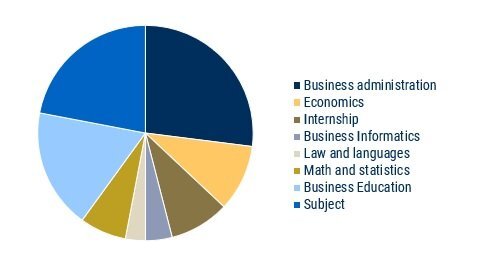
You can choose from eight focus areas within the Faculty of Economics and Business Administration at Friedrich Schiller University Jena. The 'Business Education II' study profile focuses on training to become a vocational school teacher. The focus is structured as follows:
overview study profile
Picture: Sophie BartholomeOur University also offers the following focus areas: Standard Focus, Business Administration, Economics, Business Information Systems, Information and Management Sciences, Business Analytics and Business and Economics Education Studies I. You can change your focus during your studies.
By the way: There is a mathematics bridging course to help you prepare for your studies. We strongly advise all students to attend.
How might your degree programme shape up?
| 1st semester | 2nd semester | 3rd semester | 4th semester | 5th semester | 6th semester |
| Foundations of Business and Economics Education Studies (5 ECTS) |
Introduction to Vocational Training Management (3 ECTS) |
Introduction to Business Didactics (5 ECTS) |
Introduction to Vocational Training Management (2 ECTS) |
Foundations of Empirical Research in Business and Economics Education Studies (6 ECTS) |
Bachelor’s thesis (10 ECTS) |
| Operations Management (6 ECTS) |
Seminar: Practical Business Studies I (3 ECTS) |
Seminar: Practical School Studies (3 ECTS) |
Business Administration III1 (6 ECTS) |
Business Administration IV1 (6 ECTS) |
|
| Introduction to Economics (5 ECTS) |
Pedagogical and Psychological Foundations of Learning (5 ECTS) |
Business Administration II1 (6 ECTS) |
Introduction to Business Information Systems (6 ECTS) |
Integrated Information Processing (4 ECTS) |
|
| Microeconomics (5 ECTS) |
Business Administration I1 (6 ECTS) |
Financial Accounting and Controlling (6 ECTS) |
Law for Economists (6 ECTS) |
||
| Accounting (3 ECTS) |
Macroeconomics (5 ECTS) |
Foreign Languages for Economists (6 ECTS) |
|||
| Statistics (6 ECTS) |
Subject I* (10 ECTS) |
Subject II* (10 ECTS) |
Subject III* (10 ECTS) |
Subject IV* (10 ECTS) |
|
| Mathematics for Economists (6 ECTS) |
|||||
| Practical Business Studies I: 4-week placement at a company in your mid-term break (5 ECTS) Seminar: Practical School Studies I: 4-week placement at a school in your mid-term break (5 ECTS) |
|||||
Abbreviations: ECTS = European Credit Transfer and Accumulation System (credit points)
1 You can choose from the following basic modules: Foundations of Marketing Management; Investment, Financing and the Capital Market; Organization, Leadership and Human Resource Management; Taxation / Auditing; Management; and Planning and Decision-Making.
* You can choose from the following teaching subjects: German, English, Ethics, Protestant Theology in Religious Education, French, Computer Science, Mathematics, Social Studies, Spanish; and Sports Science.
You can find more detailed information in the module catalogueExternal link.
Why study in Jena?
- High flexibility: Shape your studies according to your personal strengths and interests. You can always change direction during your studies by choosing a new focus or switching to a similar study programme.
- Research focus: The chairs of the Faculty of Economics and Business Administration de conduct research in various areas that are covered by the degree programme, such as ‘Accounting, Taxation and Capital Markets’, ‘Corporate Governance: Management and Corporate Control’ and ‘Decision and Risk’.
- Close cooperation: Make the most of our extensive network of business contacts in Thuringia, e.g. by completing an internship during your studies.
- Adventures abroad: The University and the Faculty of Economics and Business Administration de promote and encourage intercultural exchange through a wide range of programmes and initiatives. The faculty has a global network of over 50 renowned partner universities, and more first-class institutes are added on a regular basis.
- Excellent supervision: As we want our new students to feel comfortable and find their feet right from the start, the Orientation Days at the Faculty of Economics and Business Administration de provide more information on the organization of studies, institutions and university services.
What can you do after your studies?
Areas of employment for graduates
This programme will open up a wide range of career opportunities:
- in school education (e.g. qualification for teacher training at vocational colleges with a master’s degree in Business and Economics Education Studies)
- in education, training, staff development and in-house training management
- in commerce (e.g. accounting, controlling, management, production, logistics, taxes)
- in all areas of the private sector with a high demand for analytical skills (e.g. consulting firms, banks, insurance companies)
- in science and research (e.g. as a teaching associate at a university, generally with a master’s degree)
- An interest in educational issues
Downloads and links for the degree programme
What are we looking for in prospective students?
- An interest in current affairs in business and economics
- Good knowledge of German (language of instruction: German) and mathematics/statistics
- An interest in pedagogics
- Good organization skills and time management
Admission requirements
-
University entrance qualification
A university entrance qualification, such as a general secondary school leaving certificate, is required for admission onto the study programme.
More information on university entrance qualifications can be found here.
-
Language requirements
Admission and language requirements for applicants of foreign nationality and without German Abitur: www.uni-jena.de/en/study-orientation-international
Contacts
Room 4.97
Carl-Zeiß-Straße 3
07743 Jena
Google Maps site planExternal link
Opening hours:
Monday - Friday 08:30a.m. - 11:30a.m.
Carl-Zeiß-Straße 3
07743 Jena
Google Maps site planExternal link
Opening hours:
Monday: closed
Tuesday: 08.30 to 11.30
Wednesday: 14.00 to 16.00
Thursday: 08.30 to 11.30
Friday: 08.30 to 11.30
Room 4.131
Carl-Zeiss-Str. 3
07743 Jena
Google Maps site planExternal link
Room 4.128
Carl-Zeiß-Straße 3
07743 Jena
Google Maps site planExternal link
University Main Building / SSZ
Fürstengraben 1
07743 Jena
Google Maps site planExternal link
Office hours:
The Central Student Advisory Service will be closed from 22 December 2025 to 2 January 2026. We will be happy to assist you again from 5 January 2026!
We offer consultations in person, by telephone, and via Zoom. You can make an appointment by calling us on +49 3641 9-411111 (Mondays to Fridays from 9:00 to 11:00) or outside these office hours on +49 3641 9-411200. You can also use our remote help desk.
Consultation hours:
Mondays, Tuesdays, Thursdays and Fridays (9:00 to 12:20), Tuesdays (14:00 to 18:00), and Wednesdays and Thursdays (14:00 to 16:00).
Video chat: To the video chat – Zoom Videochat ZeitenMondays to Fridays (12:30 to 13:00) Password ZSB2020 Data protection informationpdf, 101 kb
University Main Building, Room E065
Fürstengraben 1
07743 Jena
Google Maps site planExternal link
Opening hours:
Information Desk (UHG; Room E0.65)
Mondays (10:00 – 12:00)
Tuesdays (13:00 – 15:00)
Wednesdays (10:00 – 12:00)
Thursdays (13:00 – 15:00)
Fridays (10:00 – 12:00)
You can also use our remote help desk at
www.uni-jena.de/service-ssz
or send us your enquiries by post.
Telephone hours:
Mondays to Fridays
(9:00 – 11:00)
Postal address:
Friedrich-Schiller-Universität Jena
Studierenden-Service-Zentrum
07737 Jena
University Main Building
Fürstengraben 1
07743 Jena
Google Maps site planExternal link