Political Science
How are laws made? What influence does the UN have? Why do wars happen? And what does peace actually mean? If you find these questions interesting, you have come to the right place!
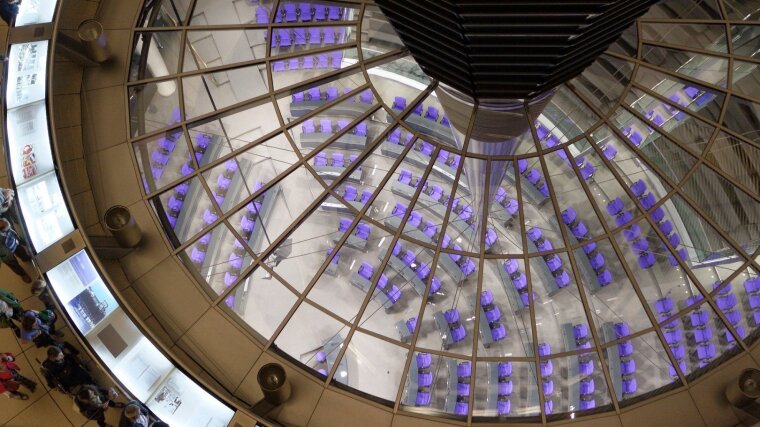
‘Don’t tell me you want to become a politician!’ Many students of ‘Political Science’ get that reaction at some point during their studies. In fact, the study programme offers far more career opportunities than many people think. It provides the technical foundations for analysing and explaining political action and events (e.g. elections or demonstrations). The range of topics is very diverse: from the study of political parties and the relationship between politics and religion to the examination of global conflicts and matters of foreign affairs and security policy.
Politics is interdisciplinary and has many overlaps with subjects such as economics, law and philosophy. That makes it an ideal minor subject to complement major subjects at the University of Jena. In order to understand events and interactions as a whole and to make political interrelations transparent, you have no choice but to read books and (English) specialist articles during your studies.
Irena and Marcel, two students of Political Science at Friedrich Schiller University Jena, offer an insight into the Bachelor's and Master's programmes.
Screenshot: Sophie Bartholome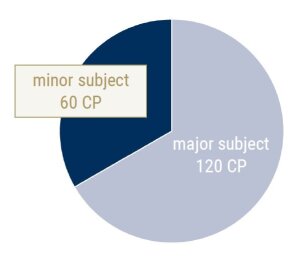
minor subject
Graphic: Sophie BartholomeThe bachelor's degree is the first professional qualification. The standard period of study is six semesters, during which various forms of courses (e.g. lectures, seminars or practical courses) are offered for the individual modules.
A multi-subject bachelor’s programme consists of a major subject with 120 credit points (CP for short; 1 CP = 30 hours for attendance, preparation and follow-up work, private study, assessed coursework and examinations) and a minor subject with 60 CP.
You can combine the minor subject ‘Political Science’ with all major subjects offered at the University of Jena. The minor subject comprises seven modules, of which you can set your own focus in five modules.
The following table shows the possible structure of your studies in ‘Political Science’:
| Semester | Modules |
| 1 |
|
| 2 |
You must take three of the following four elective modules:
|
| 3 | |
| 4 | |
| 5 |
|
| 6 |
|
Abbreviations: CP = credit points
* You can choose from the following modules: Political Systems I, Political Theory and the History of Political Thought I, Comparative Government I, Foreign Policy and International Relations I as well as European Studies I.
More detailed information can be found in the module catalogue for the study programme [in German]External link.

Franziska Martha Nolte
Image: Sophie BartholomeThe study programme provides very good basic and methodological training in the first semesters. Thanks to the small lecture and seminar sizes, there are many opportunities to talk to the lecturers, clear up any ambiguities and discuss improbable scenarios.
Franziska Martha Nolte, Political Science student
at Friedrich Schiller University Jena
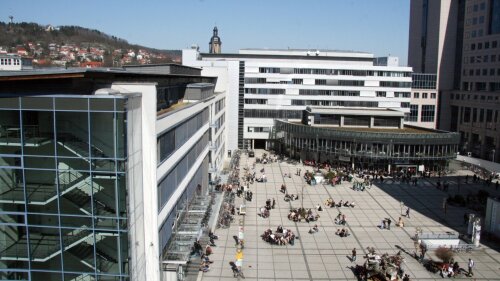
The Institute of Political Science is located on campus at Carl-Zeiss-Straße 3, right in the heart of the city.
Areas of employment for graduates

Student interviewing someone
Image: Designed by wavebreakmedia_micro / freepik.comA university entrance qualification, such as a general secondary school leaving certificate, is required for admission onto the study programme.
More information on university entrance qualifications can be found here.
Carl-Zeiß-Str. 3
07743 Jena
Google Maps site planExternal link
Carl-Zeiß-Str. 3
07743 Jena
Google Maps site planExternal link
Bachstraße 18k
07743 Jena
Telephone hours:
Mondays and Fridays (9:00 – 11:00)
Wednesdays (13:00 – 15:00)
The ASPA is primarily responsible for students in the Faculty of Social and Behavioural Sciences, the Faculty of Arts and Humanities, and the Faculty of Theology.
Postal address:
Akademisches Studien- und Prüfungsamt
Fürstengraben 1
07743 Jena
University Main Building / SSZ
Fürstengraben 1
07743 Jena
Google Maps site planExternal link
Office hours:
We offer consultations in person, by telephone, and via Zoom. You can make an appointment by calling us on +49 3641 9-411111 (Mondays to Fridays from 9:00 to 11:00) or outside these office hours on +49 3641 9-411200. You can also use our remote help desk.
Consultation hours:
Mondays, Tuesdays, Thursdays and Fridays (9:00 to 12:20), Tuesdays (14:00 to 18:00), and Wednesdays and Thursdays (14:00 to 16:00).
Video chat: To the video chat – Zoom Videochat ZeitenMondays to Fridays (12:30 to 13:00) Password ZSB2020 Data protection informationpdf, 101 kb
University Main Building, Room E065
Fürstengraben 1
07743 Jena
Google Maps site planExternal link
Opening hours:
Information Desk (UHG; Room E0.65)
Mondays (10:00 – 12:00)
Tuesdays (13:00 – 15:00)
Wednesdays (10:00 – 12:00)
Thursdays (13:00 – 15:00)
Fridays (10:00 – 12:00)
You can also use our remote help desk at
www.uni-jena.de/service-ssz
or send us your enquiries by post.
Telephone hours:
Mondays to Fridays
(9:00 – 11:00)
Postal address:
Friedrich-Schiller-Universität Jena
Studierenden-Service-Zentrum
07737 Jena
University Main Building
Fürstengraben 1
07743 Jena
Google Maps site planExternal link